Screenshots
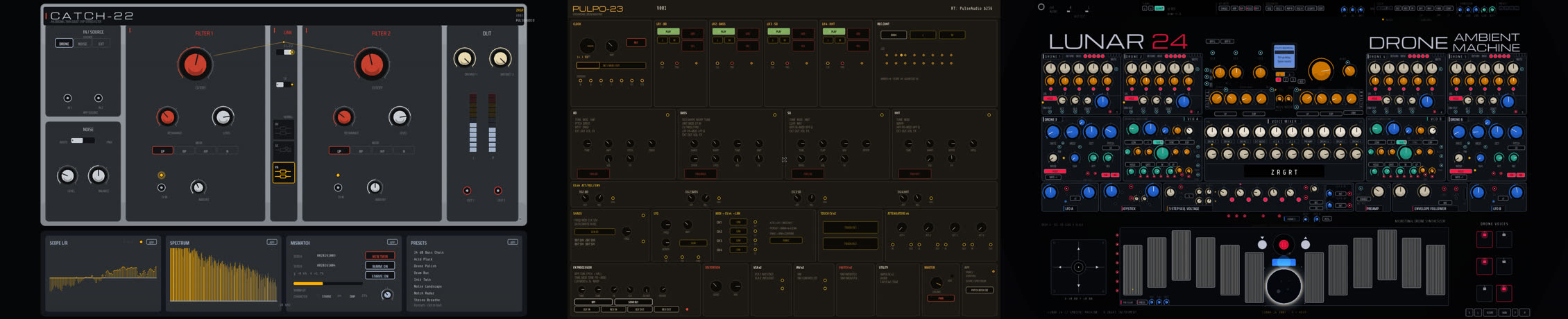
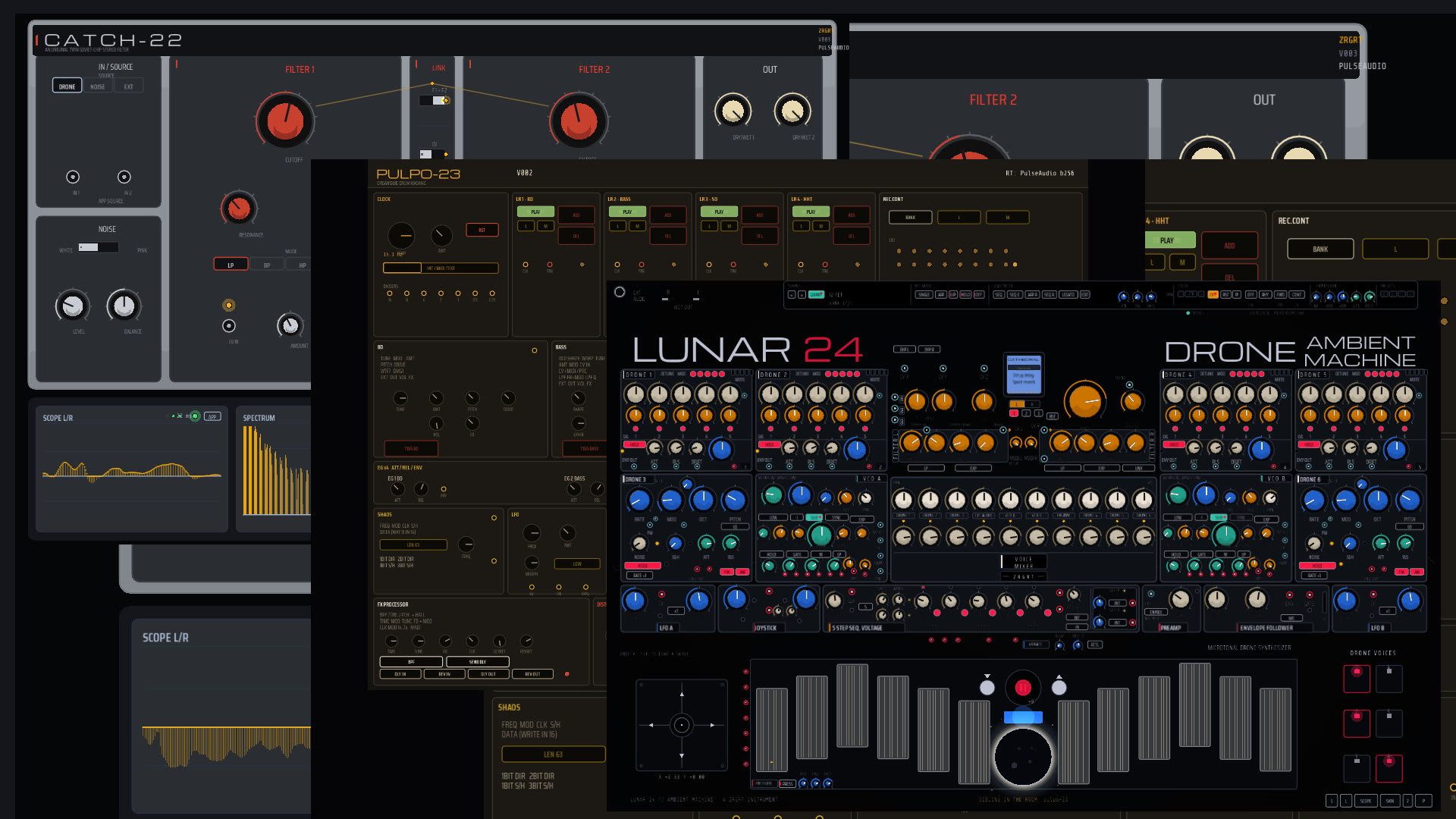
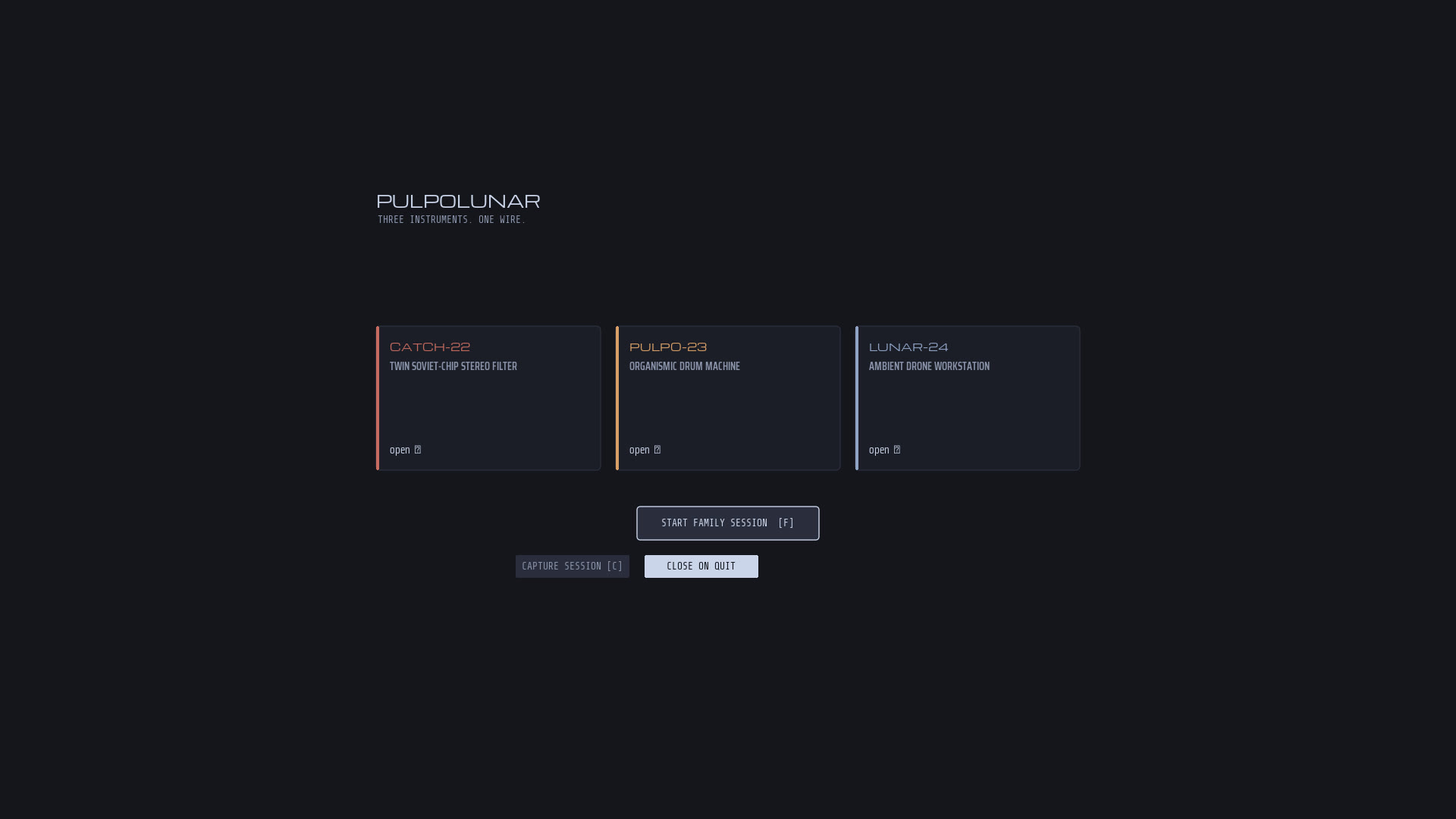
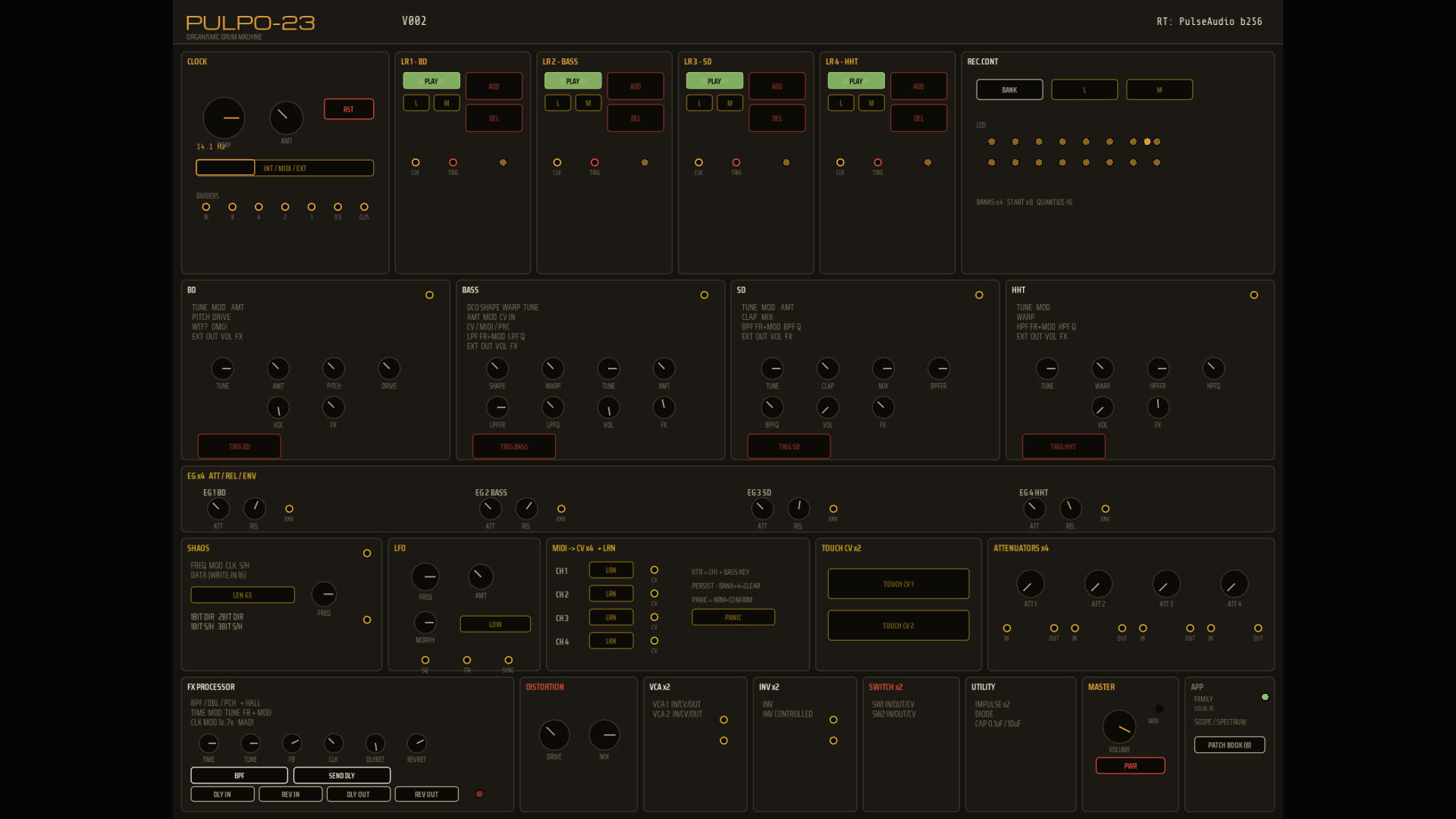
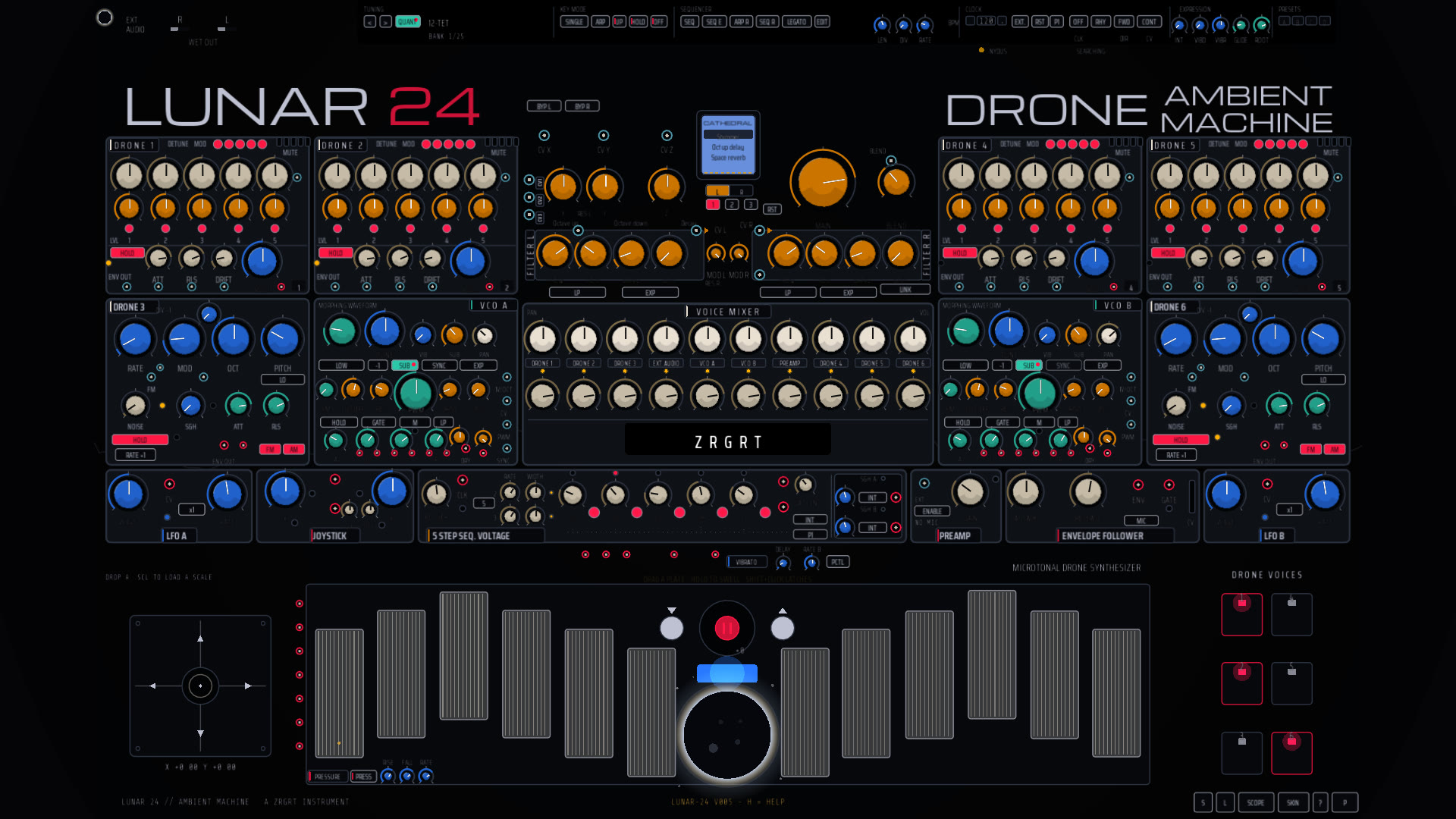
Three instruments. One wire.
Three original instruments that play together over a single connection — a microtonal ambient drone workstation, an organismic drum machine and a twin Soviet-chip stereo filter. Everything is synthesized live in code: no samples, no accounts, no tracking.
THE UNSENT LETTER — 40 seconds, performed live on LUNAR-24.
PULPOLUNAR is three instruments in one product, built to be played together. LUNAR-24 hums the room, PULPO-23 keeps the pulse, CATCH-22 shapes the air between them — clock, audio and control voltage crossing a single wire while you play.
Open it and the family is already sounding: a drone latched, a filter breathing, a pulse waiting. What you do from there is the performance.
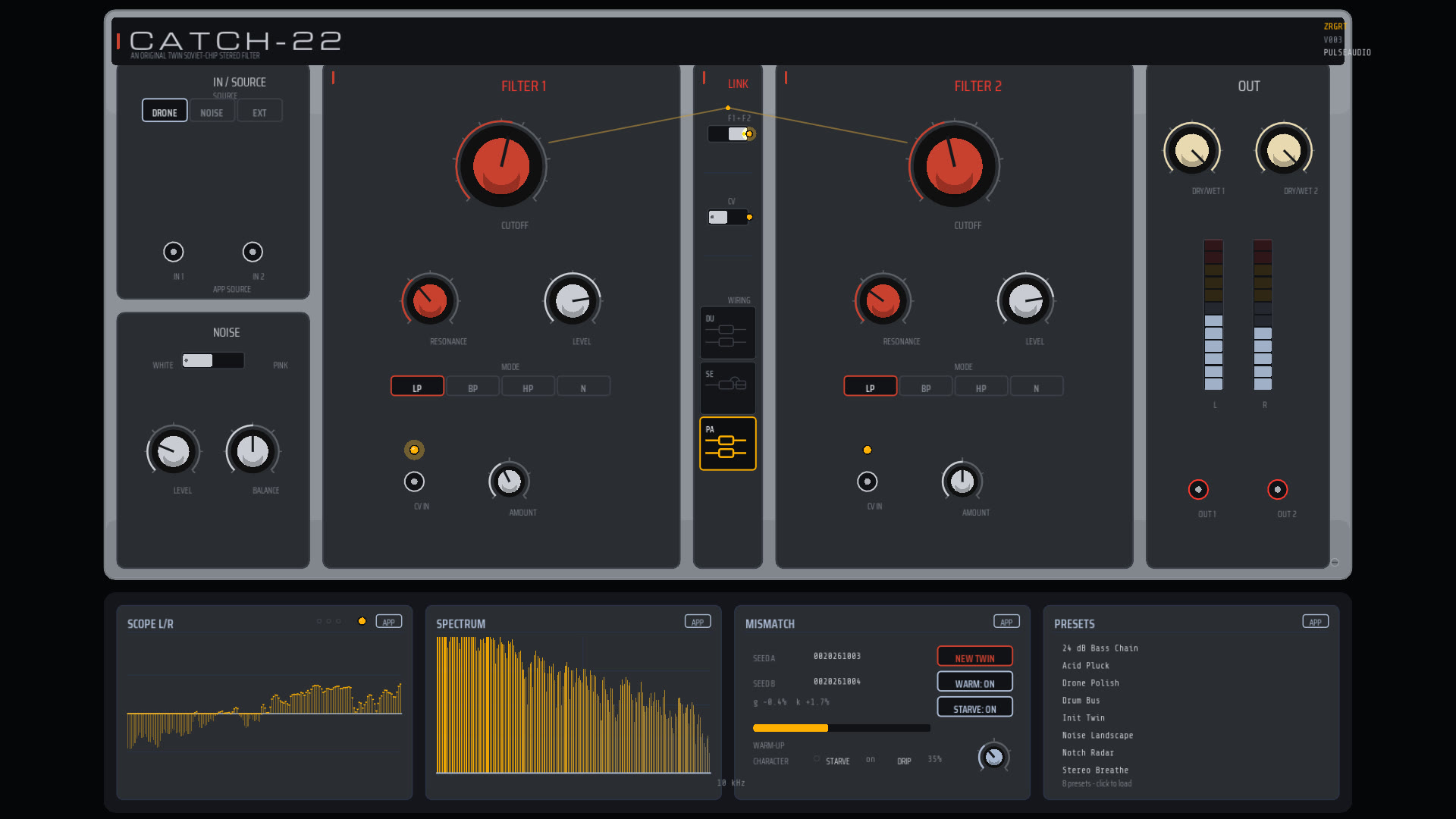
Two independent 12 dB multimode Soviet-chip-style cells (LP / BP / HP / Notch) with cutoff, resonance and level per channel, white and pink noise, CV inputs with attenuators and LED mirrors, LINK FREQ and LINK CV, and three wiring topologies — dual mono, mono series 24 dB, stereo parallel. The two channels are deliberately not identical: each carries its own UD1208 mismatch seed, because that difference is the instrument.
23 modules in one panel: four flexible sound generators (BD, BASS, SD, HHT), four AR envelope generators, a four-channel looper-recorder with banks and punch-in, a clock with binary divider array, the SHAOS pseudo-random generator, LFO, CV-controlled FX with modulated DSP clock, parallel distortion, VCAs, inverters, controlled switches — plus the auxiliary units for MIDI-to-CV, noise, attenuators, touch CV and circuit-bending primitives. It runs on a 0–10 V patch ecology where everything can interact with everything.
Eight voices: six five-oscillator drone swarms and two morphing v/oct voices with hard sync, sub oscillator and ADSR envelopes. Dual Soviet-chip-style filters, a 15-cartridge effector (45 effect programs, from space reverb to the originals MOONDOG and ECLIPSE), a 12-plate arc keyboard that is a real microtonal instrument — 25 scale banks, quantizer, arpeggiator, portamento, vibrato, twin/split — and any Scala .scl you drop in. The patchbay is a live schematic graph: 40+ sources × 28+ destinations, audio-rate patching included. The wire is a graph, not a drawing.
Run all three at once and play them as a trio: PULPO-23's clock drives LUNAR-24, LUNAR-24's output feeds CATCH-22, everything plays through one NYDUS wire with no configuration — then capture the performance as heard, no overdubs. The family sessions (streamed on this page) show what the room sounds like when the three instruments talk.
Everything is synthesized in real time. No samples, no sound packs required, mouse and multi-touch both play LUNAR-24's surface, and every instrument boots already sounding — the novice path needs no patching, the advanced path is one key away.
Two 12 dB multimode cells that are deliberately not identical — that mismatch is the sound.
23 modules on a 0–10 V ecology where any voltage is both audio and control.
Drone swarms, morphing leads and a panel that is already humming when you open it.
Public-domain works, played live by the trio over one wire and captured as heard. LUNAR-24 + PULPO-23 + CATCH-22 in one room.
LUNAR plays the triplet arpeggios · PULPO one soft pulse per bar · CATCH filters the room
Two LUNAR voices eight seconds apart · PULPO the ground bass · CATCH blooms at the third entry
The room steps 138→154 bpm over the wire · PULPO's faithful march · CATCH blooms at the climax
Fate knocks — the exposition · PULPO states the motif on timpani · CATCH the hall
The DSP runs in a native real-time bridge on Windows and Linux; a scalar path runs on non-AVX2 hosts. No GPU compute required.